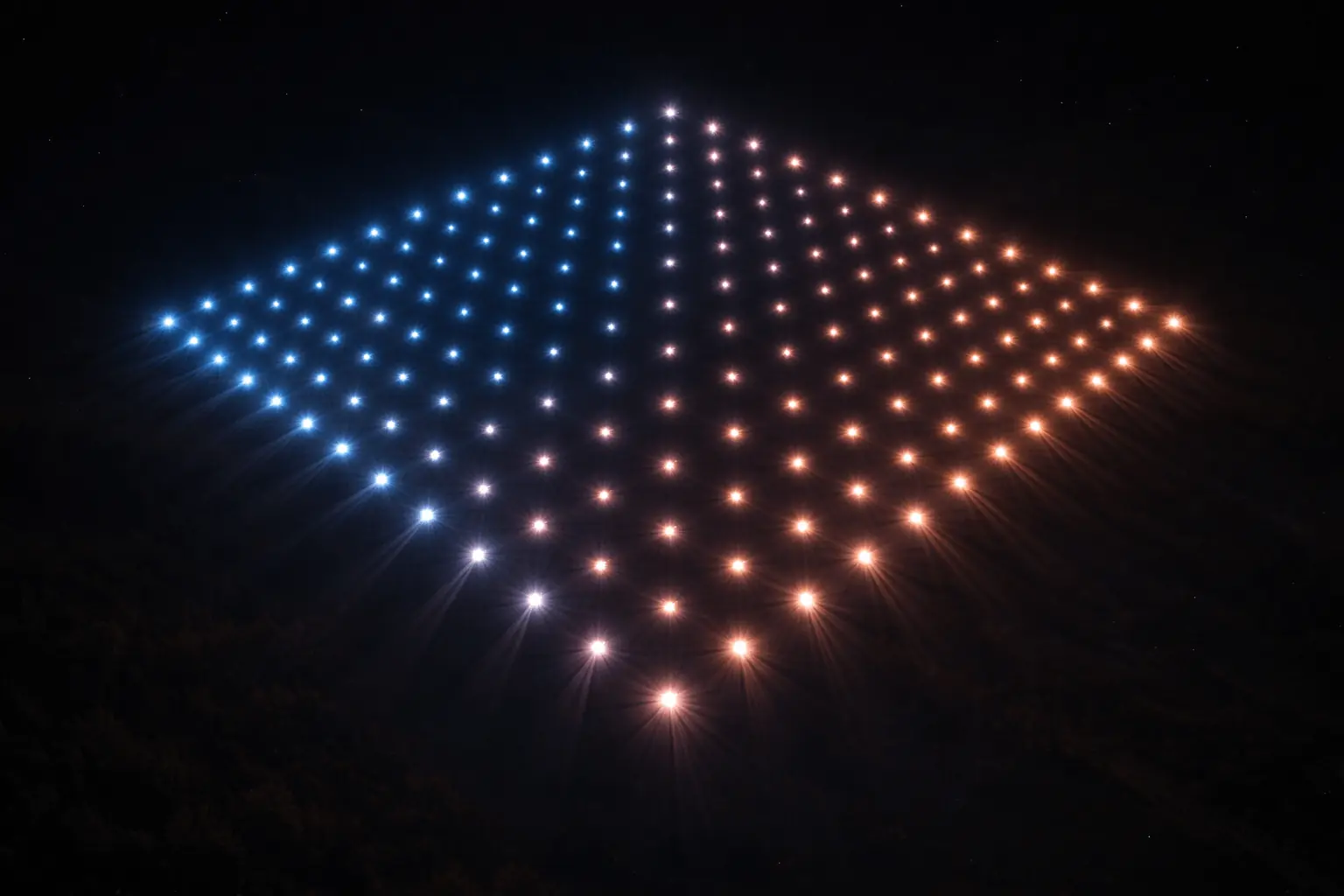
It starts with a design file
Every drone show begins as a digital design. Creatives map out shapes, transitions and timing, often working scene by scene in much the same way an editor builds a visual sequence.
That design is then translated into a flight plan, where each drone is assigned coordinates and movement paths throughout the show.
Each drone has its own position
Think of the fleet as a set of moving pixels. One drone might represent part of a logo, another part of a letter, and another part of an animation trail.
The larger the fleet, the more detail the show can carry. More drones usually mean smoother curves, clearer lettering and more room for motion.
Timing and spacing matter
The precision comes from a combination of onboard systems and carefully planned separation between aircraft. The choreography is designed so drones remain in safe relation to each other while still producing a seamless image.
This spacing is a major part of why well-produced drone shows feel calm and controlled rather than chaotic.
Rehearsal happens before launch
Long before the audience sees anything, the show has been simulated, checked and refined. Teams look at transitions, resolution, readability and overall pacing. That kind of structured workflow is why organisers often lean on experienced operators like FlightShows when the show needs to be both creative and operationally robust.
The final display may only last a few minutes, but getting to that point involves a lot of testing and judgement.
What the audience sees versus what is really happening
From the ground, the audience sees floating symbols and smooth movement. Operationally, what is happening is much more disciplined: launch planning, designated flight zones, synchronised timing and close supervision throughout.
That balance of technical structure and visual simplicity is what makes good drone shows feel impressive rather than gimmicky.
We also explore how these systems are used creatively in our drone show ideas guide.
If you’re new to the concept, it’s worth starting with our overview of what a drone light show actually is.
In practice, delivering this level of precision requires detailed planning, simulation, and coordination between multiple systems. Many of the processes involved are similar to real-world production workflows used by teams like FlightShows, where creative design and operational planning are closely linked.
Related reading
This article explores drone light shows, their design and use in live events.